A home EV charger is normally a 7.4 kW unit on its own dedicated circuit from your consumer unit. The electrician checks your supply, earthing and spare capacity first, installs and tests it, and notifies your network operator. Most homes can have one fitted, though some need a board upgrade.
At a glance
- Typical unit: 7.4 kW on a single phase supply
- Circuit: dedicated, with its own protection
- Checked first: supply, earthing, spare capacity at the board
- Notified: to your network operator (DNO), which we handle
- Grants: change often, so check current eligibility
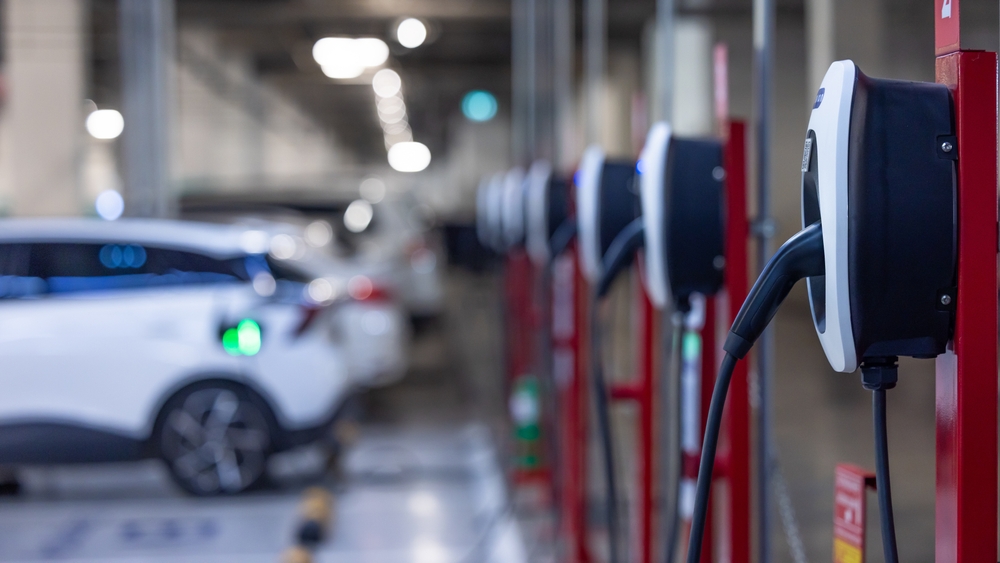
What does a home EV charger installation involve?
- Survey. The electrician checks where the charger will go, the cable route, the supply, the earthing arrangement and whether the consumer unit has room and the right protection.
- Dedicated circuit. A new circuit with its own protection runs from the board to the charger. It is not shared with anything else.
- Install. The charger is mounted and connected, with any needed earth protection.
- Test and certify. The circuit is tested and an electrical certificate is issued.
- Notify. The installation is notified to the local network operator and, as a new circuit, to building control.
That last step is paperwork we do for you. Our EV charger installation in Stafford page covers what we offer.
How fast will a home EV charger be?
| Type | Power | Supply needed | Range added per hour (approx.) |
|---|---|---|---|
| 3-pin socket (occasional use) | about 2.3 kW | Standard socket | around 8 miles |
| Standard wallbox | 7.4 kW | Single phase, 32 A | around 25 to 30 miles |
| Fast wallbox | 11 kW or 22 kW | Three phase | around 35 to 80 miles |
Range depends on the car, the temperature and how you drive, so treat these as rough. Most UK homes have a single phase supply, which is why 7.4 kW is the standard choice for a home EV charger. A 22 kW unit needs three phase, which few homes have.
What affects whether a home EV charger can be installed?
- Supply capacity. A busy supply with an electric shower, hob and heat pump may leave little spare, and a load management device may be needed.
- Consumer unit. An old board with no spare ways or no RCD protection will need replacing first. See our consumer unit replacement guide.
- Earthing. Many UK homes use a PME supply, and the charger installation has to include suitable protection against a fault on the supply neutral.
- Distance. The farther the charger is from the board, the more cable and groundwork, and the higher the cost.
- Parking. Where the car is parked and whether you share a drive or have a rented property.
Do you need to tell the network operator?
Yes. A charge point is a significant new load on the supply, so it has to be notified to the Distribution Network Operator (DNO). For most homes this is a notification, and for larger loads or weak supplies the operator may need to approve it first. We deal with this for you.
Home chargers sold in the UK must also meet the smart charge point rules, which include features such as scheduled and off-peak charging.
Are there grants for a home EV charger?
Grant schemes for a home EV charger have changed several times and eligibility is narrow. At the time of writing, support has been aimed at people living in flats or rented homes and not at everyone, and the amounts and conditions change. Check current eligibility on GOV.UK before you order.
We cannot apply for a grant for you, but we can tell you whether the installation would meet the usual conditions. Because a charger is a new circuit, it also falls under the Part P building regulations.